YouTube Watched My Farmer Suicide Documentary & Decided I Needed Help
YouTube has sent me eight automated wellness emails since 2021 - I make educational content about death. So why is the platform's mental health system flagging documentaries and asking if I'm okay?
3/17/20264 min read


YouTube's Wellness Emails Are a Joke
I make videos about death. Medical intervention, suicide, funeral costs, grief, the whole lot. And every so often, YouTube sends me an email telling me I might be in danger.
Eight times since we started in 2021. Eight.
The most recent one arrived a month ago for a video I posted back in October, asking if I was okay. It was a video about children's hospices. They say do not bite the hand that feeds you, but we are such a small channel that YouTube is not exactly feeding me anything. I reckon I am safe to talk about this crap. If you are new here, welcome. We post death related content every Friday.
Today, let's talk about YouTube's "You Are Not Alone" emails.
The Bot Behind the Curtain
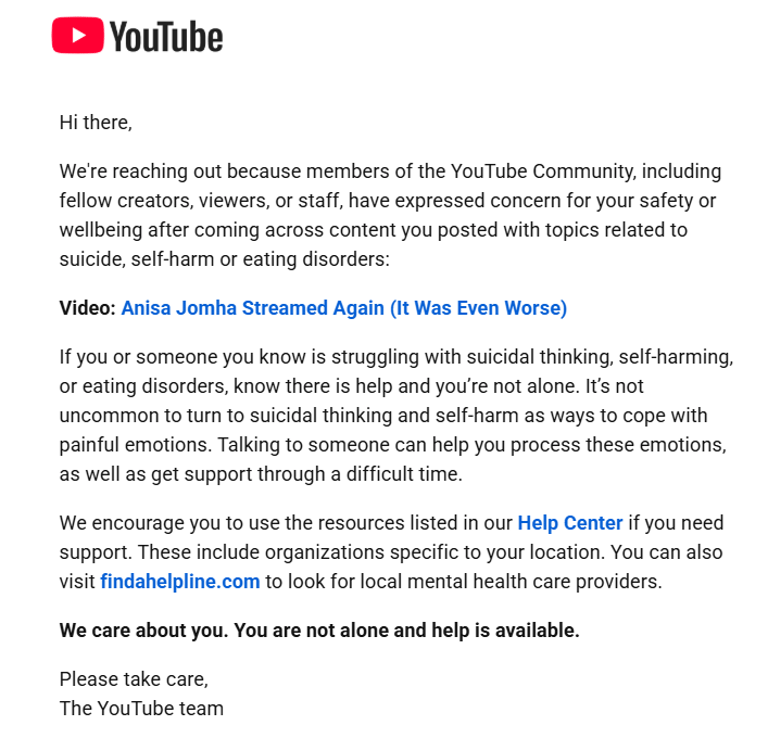
If you are unfamiliar, YouTube sends automated wellness emails to creators when their content is flagged as relating to suicide or self harm. The subject line reads: "Need help? You are not alone." It claims they are reaching out because members of the community expressed concern for my safety after watching my video on the silent epidemic of farmer deaths. It then directs me to a directory of helplines that are not even personalized for the country I am in.
Make no mistake. It was not fellow creators, viewers, or staff that triggered this email. It was AI bots. The video in question was a properly produced, educational documentary about rural suicide statistics. There was no glorification and no graphic content. It was exactly the kind of video YouTube's own policy says it supports.
"YouTube watched a video on farmer suicide rates and decided the person who really needed help was the one reporting on it." — Gary
Where Did This Come From?
To understand why YouTube does this, you need to go back to November 2021 when the platform published a blog post titled "You Are Not Alone." The pitch was simple: YouTube reaches billions of people, some of them are in crisis, so why not use that reach to point them toward help?
They expanded their Crisis Resource Panels under videos and started sending these emails to creators whose content triggered the system. The initiative launched in the middle of COVID when mental health concerns were at a record high, governments were pressuring platforms to act, and the optics of doing nothing were getting expensive.
The panels themselves are not a bad idea. But the creator emails? That is where it completely falls apart.
The Flaw in the Algorithm
In theory, these emails are for creators who might genuinely be struggling. The vlogger crying into the camera. The teenager making threats on a Live stream. If YouTube catches that, full credit to them!
But the system does not actually read your content. It runs on automated keyword and topic detection. The moment your video touches certain subjects, the machinery kicks in. The algorithm does not know the difference between a clinical psychologist reporting on suicide and a creator experiencing suicidal ideation. It just sends the same email to both and calls it a day.
The Timing Makes It Pointless
If someone posted a genuine cry for help in a video, what is the acceptable window to follow up? An hour? A day?
The eight emails I have received over the years arrived between one month and six months after the video was uploaded. Meaning if I was actually in crisis, I would have either gotten help through other means, or I would not be here to read the email.
"Nothing says 'we care' like a form letter six weeks after the fact." — Gary
The Hypocrisy
While YouTube sends delayed wellness emails to death educators, there are creators with millions of young subscribers running prank channels involving real physical danger, or posting dare content that inspires kids to hurt themselves. YouTube knows it is there. It ranks, it gets recommended, and it makes money.
The difference? The dangerous stuff is monetizable and uncontroversial to advertisers. Death education is neither. So one gets a wellness email and the other gets a Super Thanks button.
If these platforms actually cared about mental health, they would look at the mountain of peer reviewed research showing that excessive social media use is bad for young people. They would cap your daily viewing and force a hard stop. But they will not do that, because every extra minute you watch is another ad impression. No wellness email changes that business model.
A Liability Document, Not a Lifeline
YouTube is an American company, and the cultural context matters. We live in a time where people expect a large company to prevent bad things from happening. When things go wrong, lawyers appear, and every company scrambles to demonstrate due diligence.
That is what these emails actually are. A paper trail. We reached out. We provided resources. We fulfilled our duty of care. It is a ticked box designed to survive a courtroom rather than help a real person.
Now, we have creators who are terrified to use actual words in case they get penalized. But there is nothing in YouTube's guidelines that says you cannot use the words suicide, homicide, or rape. We use those words on this channel when we need to. By refusing to say them, we are agreeing that they should remain unspoken. If you are too scared to use the actual words, do not make educational content.
Eight emails in four years. All months after the fact. All sent to a channel that exists to have frank, honest conversations about death.
If YouTube were serious, the system would be capable of telling the difference between a creator in crisis and an educator covering one. Instead, it is just a trigger and a template, useful for their PR, but totally irrelevant to the people it claims to serve.
Thanks for reading, and do not forget to subscribe to the channel. Now go talk death.