Memorial Medical Centre & Hurricane Katrina
In August 2005, Hurricane Katrina didn't just flood New Orleans. It exposed exactly what happens when the infrastructure holding modern medicine together collapses completely.
3/24/20268 min read
What Happens When Medicine Runs Out
We keep people alive in hospitals by plugging them into machines. Ventilators breathe for them. Pumps push their heart. Monitors watch every vital vital sign. Drips deliver medication around the clock. All of it is entirely unnatural.
It works brilliantly right up until the power goes out, the supplies run out, and no one comes to help. That is not a hypothetical situation. That actually happened. And when it did, the people left holding the consequences were the medical staff who stayed behind.
Today we are going back to 2005 and Hurricane Katrina to talk about the disaster at Memorial Medical Centre.
The Disaster They Knew Was Coming
New Orleans is a city that sits in a bowl. It is surrounded by water on most sides and held dry by a levee system that everyone knew was aging and under engineered. It floods regularly. Hurricanes hit the Gulf Coast regularly. This was not a secret.
In 2004, one year before Katrina, FEMA commissioned a simulation called Hurricane Pam. It modelled a direct hit on New Orleans by a major storm. The virtual storm brought sustained winds of 120 miles per hour, up to 20 inches of rain, and storm surges that topped the levees. State and parish officials later said they viewed the Pam exercise as a list of commitments the federal government had agreed to fulfil.
When Katrina hit, the federal government did not do the things it had committed to doing. They knew. They planned. They did not act.
When Katrina made landfall on the 29th of August 2005, Memorial Medical Centre had 260 patients inside, along with 600 staff and over 1300 family members and neighbours who had sheltered there. The plan was to ride it out. The building was solid. They had done it before.
Then the levees broke.
What a Hospital Without Power Actually Looks Like
This is the part people do not think about. A modern hospital is entirely dependent on infrastructure. Not mostly dependent. Entirely dependent. Power runs ventilators, heart monitors, surgical equipment, medication pumps, and refrigeration for drugs. Running water is required for everything from wound care to basic sanitation. The sewage system removes biological waste.
Without any of these things, a hospital does not just become a difficult hospital. It becomes a building full of very sick people with almost no way to help them. It becomes a warehouse.
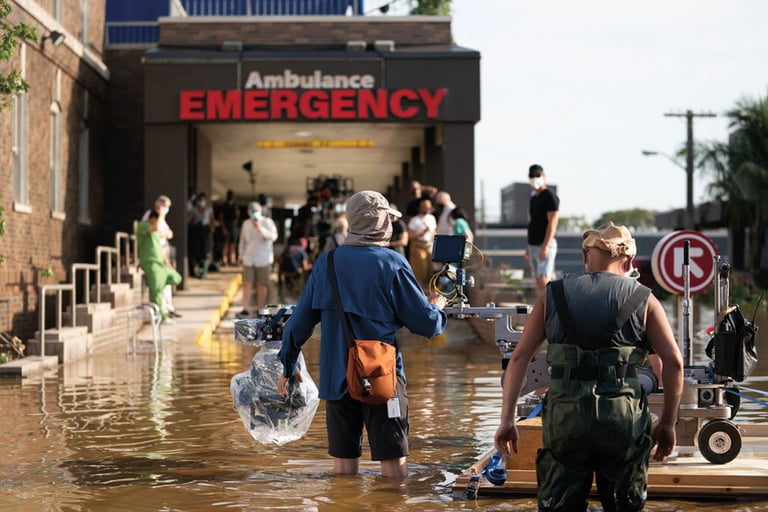
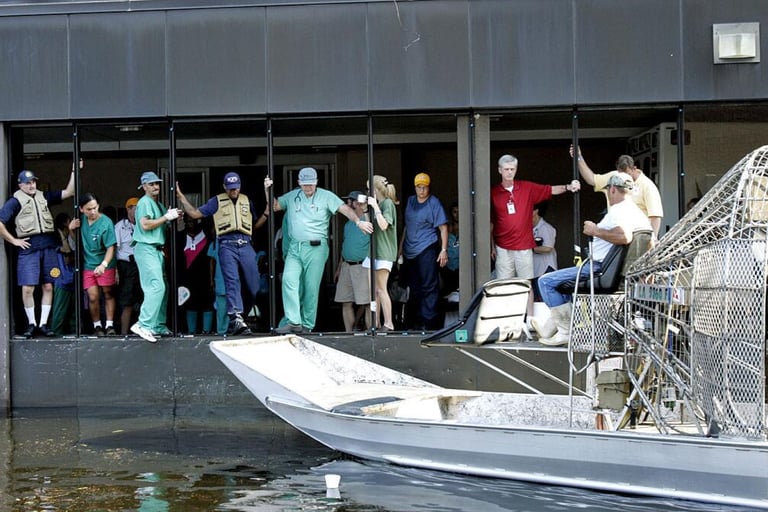
Memorial saw its backup generators fail, leaving the hospital without lights, air conditioning, sewer systems, and essential medical equipment. Why? Because the generators were in the basement. And the basement flooded.
By Wednesday, temperatures inside the sealed building hit 43 degrees Celsius. That is not just uncomfortable. At 40 degrees your body starts to cook from the inside. Elderly patients, medicated patients, and patients already fighting serious illness were the first to deteriorate.
Toilets stopped working. Sewage backed up into the hallways. The smell of decomposing bodies became so rancid it would burn the back of your throat. Bodies were stacked in a stairwell because the basement morgue was flooded and completely inaccessible.
Staff had to walk through pitch dark hallways and stairwells to reach the pharmacy. No computers. No lifts. No communications. Outside, ten feet of floodwater surrounded the building.
Keeping People Alive by Hand
Six hundred staff stayed. More than were required. Many brought their families. This was not abandonment. It was the exact opposite. And no, they were not getting paid. What they were doing in those conditions is worth understanding concretely.
Doctors and nurses were physically and emotionally exhausted. They were manually ventilating intubated patients and fanning themselves and their patients with pieces of cardboard. Manually ventilating means squeezing a rubber bag by hand to push air into a patients lungs over and over again, for hours, in 43 degree heat, in the dark. You cannot stop. If you stop, the patient suffocates.
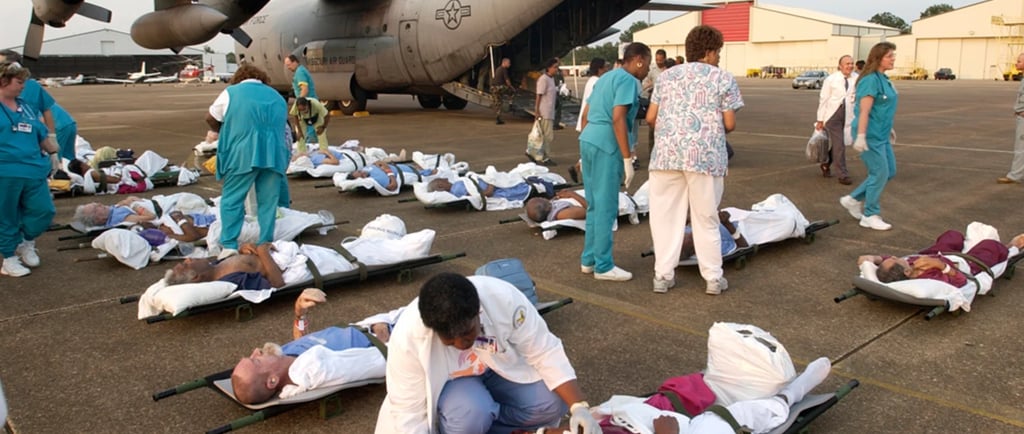
Seven patients on the seventh floor were dependent on ventilators. When the power died, that became seven people needing someone to keep their hands on a bag continuously. Some patients were carried down unlit stairwells on makeshift stretchers to be staged for boat or helicopter evacuation. Several patients died during that process.
Severely ill patients carried up to the roof could only be fanned as they waited for helicopters. By Wednesday the 31st, very few helicopters or boats were arriving. The hospital was not the priority. The entire city was drowning.
Where Was the Government?
Here is the part that needs to be said plainly.
FEMA officials turned away three Walmart trailer trucks loaded with water. They prevented the Coast Guard from delivering 1000 gallons of diesel fuel. They even cut the Jefferson Parish emergency communications line, forcing the local sheriff to restore it and post armed guards to protect it from FEMA.
More than 50 civilian aircraft responding to requests for evacuations arrived in the area a day after Katrina hit. FEMA blocked their efforts.
There was only one FEMA official in the city when the hurricane struck. He informed his director, Michael Brown, repeatedly on Monday that the levees had failed. Brown responded to one of those emails by saying the levees had held.
Where were the national guards? The Louisiana and Mississippi National Guards were in Iraq. Because the US loves a good war but not its own people.
Government officials assumed hospitals would be self sufficient for five to seven days. Private hospitals like Memorial were left entirely to their own devices. On the morning of September 1st, day four, the hospital incident commander told staff that no help was coming and that the hospital was to be abandoned.
The Brutal Reality of Disaster Triage
Here is the core of what happened, and why framing it as murder misses the point entirely.
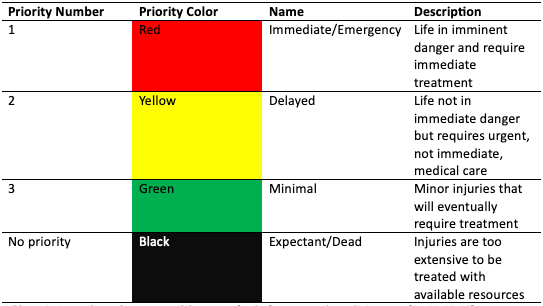
Triage in a normal hospital means sorting patients by urgency so the sickest get treated first. In a disaster, it means something harder. It means sorting by survivability. You get out those who will live. You focus resources on those who can benefit from them. You do not pour what little you have left into people who will not survive regardless.
This is not a radical idea. It is standard mass casualty doctrine. It is taught in medical schools. Militaries have done it for centuries.
The problem is it collides violently with what modern medicine has become, which is the project of keeping people alive no matter what, using whatever machinery is available. That project works when the machinery is available. When it is not available, the assumptions underneath it collapse completely.
On the seventh floor of Memorial were long term patients with chronic non healing wounds, ventilator dependency, and tube feeding requirements. Before Katrina, they were simply patients who were not well enough to go home. The power going out did not just inconvenience them. It removed the infrastructure their very lives depended on.
Patients were categorised. Those who could walk got out first. Those who were critically ill but could survive transport went next. Those deemed unlikely to survive the evacuation were categorised last.
And when the word came that no more help was coming? The media and certain politicians tried to shift the blame. Dr Anna Pou, a cancer surgeon who had volunteered to stay, was alleged to have administered morphine and midazolam to remaining patients on the seventh floor. The stated intent, according to her defenders, was palliative. To ease suffering in people who were already dying. According to the prosecution, it was killing.
The honest answer is probably both, and neither, and something in between that the law is not built to process.
The Emmett Everett Decision
Here is the case the media clung onto to show people that these doctors were evil. It was a narrative strung together by people in clean dry offices whose biggest decision that day was probably which car to drive to work.
Emmett Everett was at Memorial waiting for a routine surgery. His condition was not life threatening. He was alert. He ate his breakfast that morning. He watched his roommates get taken down one by one, and he asked the nurses not to leave him behind.
The issue was that he was also a paraplegic who weighed 170 kilograms.
Think about what moving him actually meant. Dead weight. He cannot help. 170 kilograms of dead weight carried by exhausted staff who have been awake for four days, through seven flights of unlit stairs in 43 degree heat. Up to the roof and into a helicopter with a strict weight limit, a spot that could otherwise take two or three people.
One trip. One man. Multiple other people who do not get that trip.
That is not cruelty. That is not ableist. That is arithmetic. That is reality. The natural world does not care about your feelings, and a disaster is just the natural world with the polite fiction of civilisation stripped away.
His death is sad. It is also the most honest illustration in this entire story of what it actually looks like when the infrastructure collapses and someone has to make a call that no protocol prepared them for. A call they would never have to make if the government had bothered to show up and help.
Arrested for Staying
Nearly a year later, Louisiana Attorney General Charles Foti decided to have Dr Pou arrested on charges of second degree murder. Two nurses were also arrested.
At his press conference, Foti announced that giving those drugs was plain and simple homicide. He completely ignored the irony that the government was very happy to let those exact same patients die a very slow and painful death by simply not showing up to rescue them.
Foti was running for re election, so he needed a big media headline to stay in the news. He lost that election, by the way.
The grand jury declined to indict Dr Pou in 2007. The charges against the nurses were dropped months earlier. Dr Pou was heavily backed by multiple medical societies, and the public broadly viewed her as a hero. The State of Louisiana eventually paid her legal fees and several lawmakers formally apologised.
But the point remains. The same government that ignored the Hurricane Pam simulation, turned away water trucks, blocked civilian aircraft, and gave hospitals no evacuation plan decided to arrest the doctor who stayed behind to help.
The Illusion of Safety
Modern medicine has made a promise it cannot always keep. It promises that being in a hospital means being safe. It is a promise built on the assumption that the power stays on, the supplies keep coming, and the infrastructure holds.
When none of that is possible, the people inside a hospital are not safer than anyone else. They are actually more vulnerable because they were already sick, and now the machines keeping them alive have stopped.
The patients at Memorial were not failed by the staff. They were failed by the government. The staff at Memorial were not failed by medicine. They were failed by planning, by a disaster response that had been wargamed and then completely ignored. And then they were prosecuted for the consequences.
The question this raises is not really about Dr Pou. It is about the deal we have made. We like to believe that keeping people alive at any cost is always the right call, that someone will always come to the rescue, and that the system will hold.
Because when the system breaks down, someone has to make decisions they were never prepared for. And then someone else, sitting in a fancy office, gets to decide whether that was murder.
Go talk death.