Death: Humanity's Oldest Spectator Sport
Death has always been entertainment. From public executions and medieval blood sports to morgue viewings, mummy unwrapping parties, and modern true crime obsession, humans have never really stopped watching the dead.
2/10/20264 min read


Death: Humanity's Oldest Spectator Sport
Humans have always been curious creatures. While governments try to restrict us and religious activists often preach a sense of guilt regarding our fascination with mortality, it hasn't done much to curb the appetite. People have always found a way around the rules—they always will.
We’ve been sold the idea that we must find death morbid, uninteresting, or shameful. But history tells a very different story. Today, we’re looking at how human death has been packaged as entertainment, from the blood-soaked arenas of Rome to the polished screens of the modern day.
Watch Death: Humanity's Oldest Spectator Sport
The "Family Day Out" of Public Executions
From Ancient Rome to the French Revolution, public executions drew crowds in the thousands. People traveled great distances with excitement to watch the "show." While governments claimed these events taught morals, the drinking and festivities in the crowd made that hard to believe.
In the Roman Colosseum, executions were often the lunchtime entertainment between gladiator bouts. Contrary to popular belief, gladiators were expensive celebrities and didn't die as often as we think. The public still wanted blood, however, so the government provided grisly executions via wild animals to fill the gap.
By the 1700s and 1800s, beheadings in France and hangings in England were essentially public holidays. Students were let out of school early, and street vendors made a fortune selling food, drink, and souvenirs. It was truly a great day out for the whole family.
Gary’s Take: "Family bonding at its finest. Nothing brings people together quite like a good beheading."
Medieval Blood Sports and Theatrical Torture
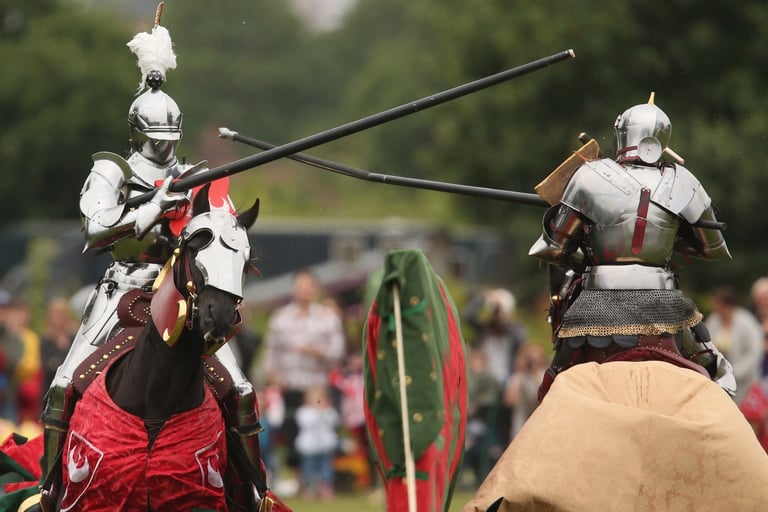
Medieval jousting wasn't just a game; it was practice warfare, and it was deadly. In one tournament in Cologne, Germany, over 60 knights were killed in a single event. The crowds loved every minute of it.
Then there was Trial by Combat—legally sanctioned duels in tiered arenas called "the lists." In 1386, the famous combat between Jean de Carrouges and Jacques Le Gris drew royalty and nobility alike. The crowd was in a holiday mood, eager to see if Carrouges would die or if his wife would be burned alive as a consequence of his loss.
The Original Double Feature: Public Dissections
Between the 16th and 18th centuries, anatomical theaters across Europe held public dissections. These were elaborate tiered amphitheatres in cities like Padua and Bologna that accommodated hundreds of paying spectators.
Because the bodies were usually executed criminals, you could attend the execution in the morning and watch the dissection in the afternoon. These events featured music, rowdy hecklers, and even tourist guides. It was less about medical discovery and more about a spectacular, ceremonial show.
Parisian Morgues and Mummy Parties
In the 1800s, the Paris Morgue became a "must-see" tourist attraction. Guidebooks listed it alongside museums. Men, women, and children crowded the glass to gape at unclaimed bodies. If there were no bodies on display, angry crowds would actually complain that death was "taking an intermission."
Meanwhile, in Victorian England, "Egypt-mania" led to Mummy Unwrapping Parties. Tickets were sold to watch a surgeon slowly reveal a face hidden for millennia. Souvenirs—bone fragments or bandages—were sold to the highest bidder.
The Changeover: From the Square to the Screen
Around the start of the 1900s, death entertainment didn't diminish—it just moved. Executions went behind prison walls, but the "Penny Press" began printing sensational, gory details of local murders. Society’s bloodlust simply shifted from seeing death in person to using media to imagine it.
Today, we pretend we are more civilized because we watch it on a screen. We watch blood sports like MMA, true crime documentaries, or "cartel murders" on internet forums.
Gary’s Take: "At least our ancestors got fresh air and exercise walking to executions. You lot just sit on the couch watching Dexter."
Modern Macabre: Body Worlds and Dark Tourism
Fast forward to today:
Body Worlds: Exhibits display plasticized, skinless bodies. While they claim it’s for education, curiosity and the macabre are what drive the revenue.
The Paris Catacombs: Over 6 million people visit each year to see walls of human bones.
Museum Mummies: We can’t have an Ancient Egypt exhibit without a body; we want to look away, but a bigger part of us wants to gawk.
A Dark Look into the Future
Perhaps the most unsettling modern rumor is the idea of "human hunting." From dark web "kill rooms" to rumors of wealthy tourists paying to shoot civilians in war zones, the idea of death for sport remains a terrifying undercurrent of human behavior. Deplorable? Yes. Surprising? Given our history, perhaps not.
Final Thoughts
Why are we like this? Curiosity about the unknown is a human instinct. It's part of survival. Wanting to learn about and see death isn't necessarily something to be ashamed of—it is a massive part of our history, art, and science.
But there is a line. Where do you think that line is?
What other ways do you see death being used as entertainment today? Let us know in the comments.
Go talk death.