5 Nutritional Deficiencies That Killed Millions
What if we told you that diseases which killed millions of people were cured by eating an orange, adding something to table salt, or simply not removing part of a grain? In this video, we're diving into the most horrific nutritional deficiencies in human history.
3/9/20265 min read


Horrific Nutritional Deficiencies We (Thankfully) Don’t See Anymore
What if I told you that we used to have common medical conditions that would make your old childhood scars spontaneously rip back open? Or that there were illnesses that killed thousands of people every year that we now completely prevent with… table salt?
We're talking about severe nutritional deficiencies. These were conditions that used to be absolute death sentences, but are now so rare that most modern doctors will never see a single case in their entire career.
And the wild part? We didn't cure them with fancy, groundbreaking medicine. We mostly stumbled into the solutions by accident.
Here is the thing about nutritional deficiencies: they are historical proof that for most of human existence, we had absolutely no idea what we were doing when it came to food. We knew we needed to eat to survive, but we didn't understand that specific nutrients were doing specific, vital jobs inside our bodies.
People would follow perfectly reasonable dietary practices—like polishing rice to make it prettier, or eating only preserved foods on long sea voyages—and then mysteriously start dying in horrific ways.
The diseases we're about to discuss killed millions of people and devastated populations. Yet, they were entirely preventable with food that was often sitting right there.
Here are five historical nutritional deficiencies that absolutely wrecked humanity.
Want to watch the full video? Don't forget to subscribe to the channel for new death-related content every Friday!
1. Scurvy: When Your Body Literally Falls Apart
Let's start with scurvy, because it's probably the most famous on this list, and for good reason—it's an absolute nightmare.
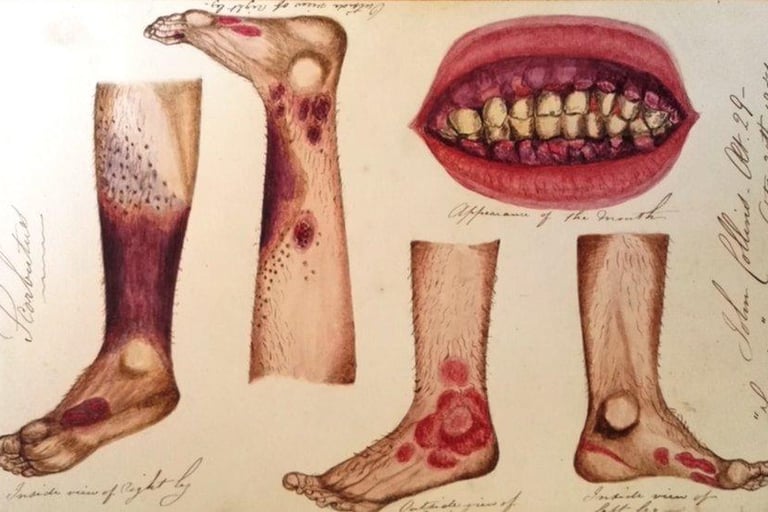
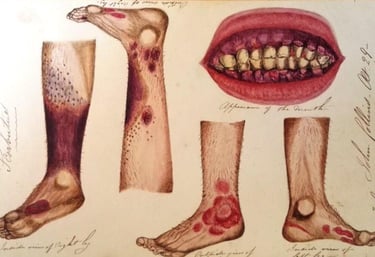
Scurvy is caused by a lack of Vitamin C. Your body desperately needs Vitamin C to make collagen, which is basically the biological glue that holds you together. Without it, that glue starts to dissolve:
Your gums turn black and spongy.
Your teeth fall out.
You develop massive bruises as blood vessels rupture under your skin.
But here's the truly horrifying bit: in advanced cases of scurvy, old wounds and scars—injuries that healed years ago—spontaneously break back open. Your body is literally unmaking repairs it did in the past because it no longer has the materials to maintain them.
Scurvy was the bastard of all maritime diseases. Ships would leave port with full crews and arrive with half the men dead. It’s estimated to have killed two million sailors between 1500 and 1800.
The cure? Citrus fruit. Lemons, limes, oranges. British naval surgeon James Lind even proved it worked in 1747 with one of the first controlled clinical trials in history. But the British Navy didn't make citrus juice mandatory until 1795—nearly 50 years later.
2. Rickets: When Your Bones Forget How to Bone
Rickets is what happens when children don't get enough Vitamin D.
Vitamin D helps your body absorb calcium, and calcium makes bones hard. Without it, children's bones stay soft and bendy, leading to bowed legs, knock knees, curved spines, and a string of bumps along the ribcage where the ribs actively deform.
This disease was absolutely rampant during the Industrial Revolution. Children worked 14-hour days indoors in factories and lived in cramped, sunless housing. Since your body makes Vitamin D from sunlight, these kids were starving for it. In Victorian England, bowed legs were just considered "normal" for working-class children.
The solution ended up being elegantly simple: fortify milk with Vitamin D. This started in the 1930s, and rickets cases plummeted. We literally just added the vitamin to something kids were already drinking.
3. Pellagra: The Four Ds of Death
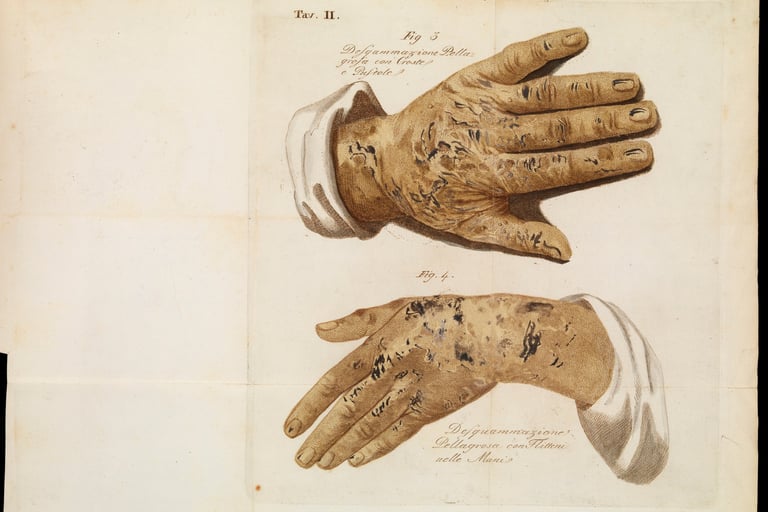
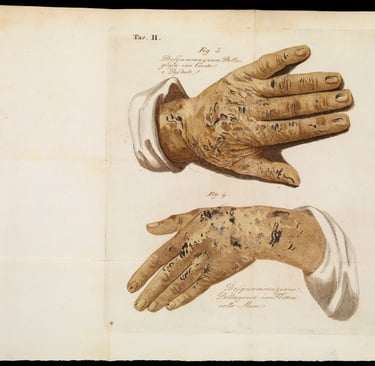
Pellagra is caused by a lack of Niacin (Vitamin B3), and it was epidemic in the American South in the early 1900s. It was known as the disease of the "Four Ds":
Dermatitis: A symmetrical, burn-like rash on sun-exposed skin that would darken, crack, and peel.
Diarrhoea: Relentless and bloody.
Dementia: Confusion, hallucinations, aggression, and eventually complete psychosis.
Death: Usually within four to five years of the first symptoms.
For years, doctors thought pellagra was an infectious disease. They looked for bacteria while people were literally just starving for a specific nutrient. Poor Southern families subsisted almost entirely on cornmeal, salt pork, and molasses. While corn does contain niacin, humans can't absorb it unless the corn is treated with an alkali (like in traditional Mexican nixtamalisation).
In 1915, Dr. Joseph Goldberger proved it was a dietary issue through a series of experiments that would never pass an ethics review today—he literally induced pellagra in prison volunteers, then cured them by adding meat and vegetables to their diet.
By the 1940s, we started enriching flour and cornmeal with niacin, and the disease essentially vanished within a decade.
4. Beriberi: The Rice That Killed Millions
Beriberi is what happens when you polish your rice to make it look fancier and accidentally remove all the Thiamine (Vitamin B1).
There are two main types, and both are miserable:
Wet Beriberi: Causes heart failure and severe swelling.
Dry Beriberi: Destroys your nervous system, leading to muscle wasting and paralysis.
Beriberi became a massive problem in Asia in the late 1800s when industrial milling allowed for the mass production of white rice. Brown rice has thiamine in its outer layers, but polishing it off strips the nutrition. Populations that had eaten rice safely for thousands of years suddenly faced an epidemic.
The Japanese Navy lost thousands of sailors to beriberi in the 1880s until a naval doctor figured out the diet connection and added meat and barley to their rations. Once we figured out that we just needed to either enrich white rice or leave the bran on, the epidemic ended.
5. Goitre: The Iodine Solution
Finally, let's talk about goitre. This is what happens when your thyroid gland swells up to massive proportions because it's desperately trying to function without enough Iodine.
Your thyroid needs iodine to make hormones that regulate your metabolism. Without it, the gland enlarges into growths the size of grapefruits on the neck. Severe iodine deficiency also caused cretinism—stunted growth and severe intellectual disability in children.
Goitre was incredibly common in inland areas far from the ocean (like the Alps or the Great Lakes), where soil and water naturally lack iodine. Entire villages had swollen necks, and it was just accepted as a fact of life.
The cure? Add iodine to table salt.
Switzerland started iodising salt in 1922. The US followed in 1924. Within a few years, goitre rates plummeted. A problem that had plagued humanity since the beginning of recorded history was essentially eliminated by slightly modifying a standard table condiment.
The Accidental Cures
Here is what is truly wild about these diseases: they killed millions of people, disabled children, and depopulated entire regions.
But we didn't defeat them with groundbreaking surgeries, radiation, or miracle drugs. We defeated them by accident. By trial and error. By simply adding things to the food we were already eating.
Scurvy? Eat an orange. Rickets? Drink fortified milk. Goitre? Use iodised salt.
These solutions seem incredibly obvious to us now, but it took humanity thousands of years and millions of deaths to figure out that food is more than just fuel.
It makes you wonder: It's easy to look at modern diseases like cancer, heart disease, or Alzheimer's and assume they're just an inevitable part of the human condition. But scurvy and pellagra were once considered mysterious and inevitable, too. We didn't cure these nutritional deficiencies—we prevented them.
What modern conditions that we accept as "just part of life" might actually be preventable with knowledge we just haven't connected yet?